A teardrop flag is really three materials working together: a knitted polyester banner, a printing process that lives inside the fibers rather than on top of them, and a flexible pole that has to bend in gusts without snapping. Most buying decisions get made on price and artwork, but the material spec is what determines whether a flag reads clearly at 40 feet and still looks that way six months in. This is a look at what each part is made of and what those choices actually change on the ground.
The banner: knitted polyester, read by weight
Nearly every advertising flag is printed on knitted polyester rather than a woven fabric. The knit has a slight stretch that lets it sit taut in the pole sleeve and hold its teardrop shape in light wind instead of wrinkling. What separates a cheap flag from a durable one is fabric weight. A common single-sided flag uses roughly 3.5 oz material, while a double-sided flag is built from two layers of about 4.3 oz fabric with a light-blocking layer sandwiched between them. Many suppliers describe their premium standard as a 115 g/m² knit, which is close to 4 oz and is the point where durability starts to hold up outdoors.
The reason weight matters is UV and flex fatigue. A 115 g knit polyester is generally rated to withstand more than 2,000 hours of direct sunlight under ASTM G155 accelerated-weathering testing before meaningful degradation, whereas the 2 to 3 oz economy fabrics fade and grow brittle noticeably faster. If your flag will live in full sun, the fabric weight is the single spec most worth paying up for. A mesh polyester variant exists for very windy sites; the roughly 30% open weave cuts wind load by about half, at the cost of some color vibrancy.
The print: dye sublimation, and why the reverse side matters
Quality flags are printed by dye sublimation, where heat turns solid dye into gas that bonds into the polyester fibers themselves. Because the color becomes part of the fabric rather than a coating sitting on the surface, it does not crack or peel and it survives washing and weather far better than screen or direct print. On a colorfastness scale, well-made sublimated flags land around a 4 to 5 rating under ISO 105-B02, which is near the top of the scale.
Sublimation also explains the single- versus double-sided choice. On a single-sided flag the ink strikes through the fabric, so the back shows a mirror image at roughly 80 to 90% of the front’s intensity, which is fine for a logo but wrong for text meant to be read from behind. A double-sided flag solves this with that internal blockout layer and two separately printed faces, so both sides read correctly at full opacity. Many flags also carry a durable water-repellent finish that sheds rain and lets the fabric dry within 30 to 60 minutes, which matters because a flag that stays wet sags and invites mildew.
The pole: the material that sets your wind ceiling
The pole is where flags most often fail, and the material is the deciding factor. The workhorse is epoxy fiberglass, typically CE-certified with stainless steel sleeve reinforcement at the joints, and usually backed by a two-year warranty. Fiberglass bends deeply and springs back, which is exactly what you want in a gust. Where budgets allow, carbon composite poles offer the longest service life, on the order of 3 to 10 years, and aviation-grade fiberglass commonly runs 5 years or more. The weak option is an aluminum-and-fiberglass combination, which tends to last only 1 to 2 years because the rigid section concentrates stress and eventually cracks.
Pole sets scale with the flag. Kits run from an extra-small pole around 79 inches, or roughly 6.5 feet standing, up through medium sets near 10 feet, large near 13 feet, and jumbo poles around 194 inches, close to 16 feet in the air. Height buys visibility but also leverage on the base, so taller flags demand heavier ballast. On wind: standard fiberglass poles handle a sustained 20 to 30 mph comfortably, and the practical guidance is to take the flag down somewhere between 24 and 40 mph depending on pole grade. Nothing extends pole life like pulling the flag before a storm.
How long the whole system lasts, and what fails first
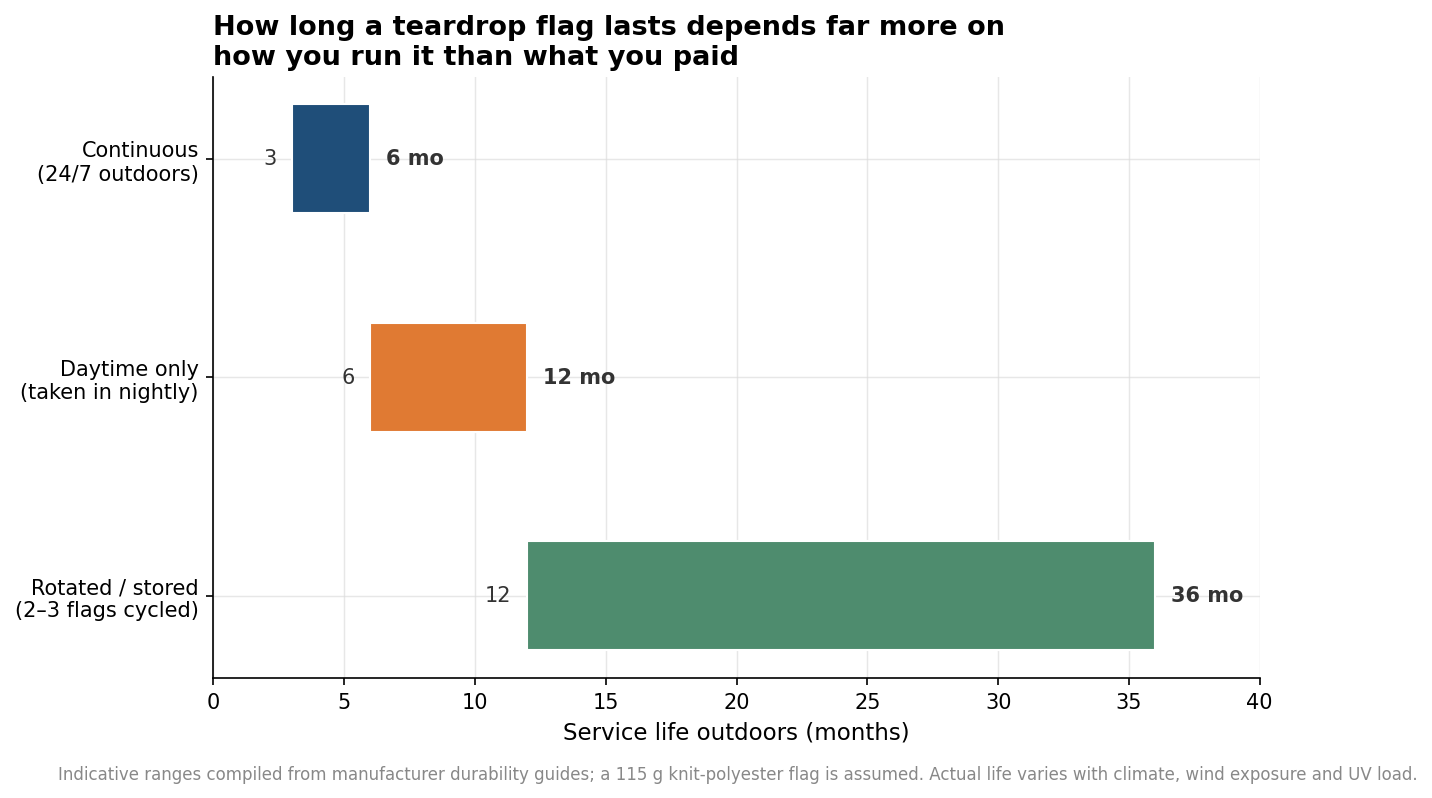
Lifespan is less about the price tag than about how the flag is run. A flag left outdoors continuously, day and night, typically holds up for 3 to 6 months. The same flag brought inside each evening commonly lasts 6 to 12 months. And a flag that is rotated with two or three others and stored dry between shifts can stretch to 1 to 3 years or more, with rotation alone often taking a 6-month flag past 18 months. The failure almost always starts at the fly end, the outer tip that whips fastest and racks up the most flex cycles, which is why reinforced fly-end stitching is worth checking for. In harsh, high-UV climates, expect 40 to 50% color fade well before the fabric physically tears.
Care is unglamorous but decisive. Inspect the fly end monthly, rinse the fabric every couple of months with lukewarm water and mild soap, never bleach, and always store the flag completely dry in a cool, dark place. Those habits are what separate the people replacing flags twice a year from the people getting two years out of a set.
Matching the base to the ground you have
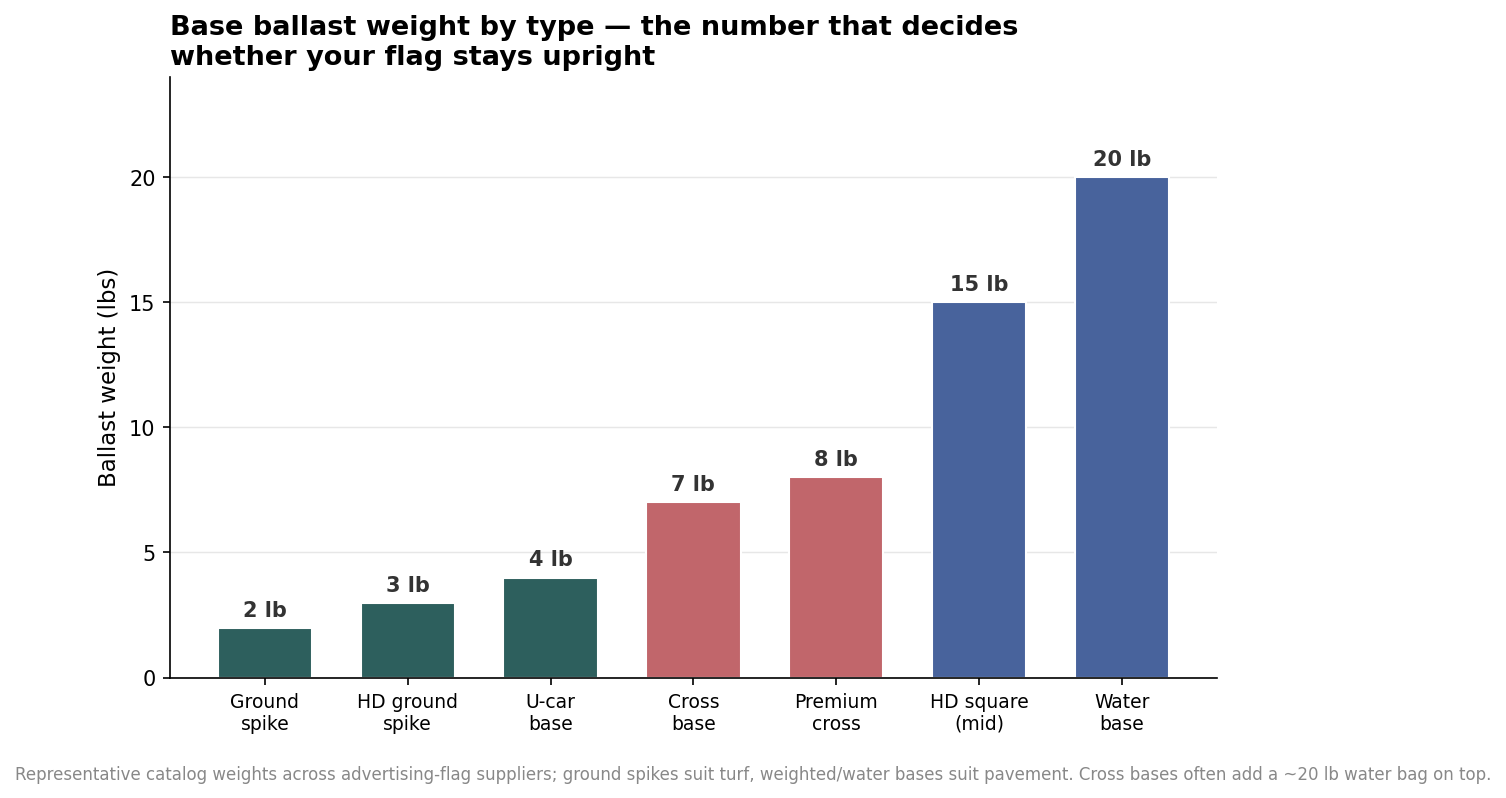
The base is a material decision too, because the right ballast depends entirely on your surface. On grass or soft ground, a ground spike weighing 2 to 3 pounds bites in and does the job cheaply. On pavement, concrete, or any hard surface, you need a weighted or water-fillable base, and the weight climbs quickly: cross bases around 7 to 8 pounds, heavy square bases from 11 to 22 pounds, and water bases near 20 pounds. A U-shaped car base around 4 pounds tucks under a tire for events. The pattern below shows how those options stack up.
Premium flag-and-pole kits cost more than basic ones, and bulk custom-printed orders generally come in lower per unit; the exact figure moves with size, print sides, and hardware, so ask for a quote rather than relying on a market average. The larger point is that fabric weight, print method, and pole material are the three specs that decide whether a flag is a three-month disposable or a two-year fixture, and they are worth asking about before artwork ever enters the conversation.